Your systems are connected. The logic that runs them isn’t. TDL puts the logic that runs your business in one place. Build the logic once and use it everywhere. Finally, your whole enterprise can run like one team.
Your people are the human API. When two systems disagree or don’t integrate your way of doing business, it’s a person who reconciles them by hand. It’s the same story every close, every budget cycle, and every model iteration because each system and department carries their own definitions and context. IT has tried better integrations and point solutions, but the challenges persist. The problem was never your team.
01
A slow close isn't a data problem.
Across entities in different countries and currencies, the monthly and annual close take weeks. Currency conversion is rarely what holds it up. It’s usually something smaller and harder to isolate. One entity books an accrual at a threshold another wouldn't, or files an expense under a category its neighbor treats differently. Before anything can roll up, someone has to sit down and square those differences by hand.
The organization connected the systems. Nobody connected their individual definitions and context.
02
Budgeting takes a full quarter year after year.
Building the annual budget for your assets and portfolios runs a quarter or longer. Most of that time is not spent deciding anything. It goes into redoing the math every time an assumption changes. The projections and variance analysis have to be rebuilt by hand across dozens of separate models. There is no single place that holds the logic connecting an assumption to a number, so the work starts over each time.
The budget review becomes a sluggish cycle of redoing the math and process instead of deciding on strategy.
03
Excel is load-bearing.
The logic that actually reconciles your enterprise lives in a workbook with no owner, no version history, and no audit trail. Not because your team reached for a workaround, but because the spreadsheet was the only place flexible enough to hold the necessary logic.
The problem was never the spreadsheet. It's that the logic had nowhere governed to live.
04
One asset, three different truths.
A property manager, an asset manager, and accounting look at the same free-rent period and each book a different number. All three are right by their own rule. Things like free rent, abatements, and security deposits get spread across time in ways that are open to interpretation, and nobody owns the cross-system interpretation. A SaaS team runs into the same thing on ratable versus usage revenue, a builder on percentage of completion.
Three systems, three answers, and every one of them is correct.
05
You reclass a journal, and no one downstream hears about it.
When accounting reclasses a revenue or expense journal, the change never makes it back to the other systems and reports running on the old logic. The business units’ data drifts apart again, and the reconciliation you thought you closed last period opens right back up. This is the exact failure a recent integration was implemented to fix, yet it stubbornly returns.
A reclass changes what a number means, and that is something an integration cannot carry.
06
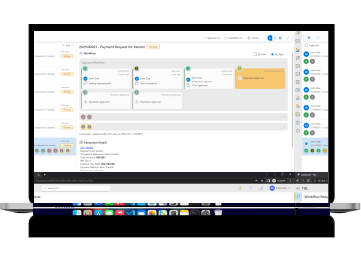
Payment approvals stall in inboxes.
An Opex or Capex approval can sit for weeks, and the stretch from invoice to bank transfer sometimes runs into months. Moving the money was never the slow part. The rules for who signs off on what live in email threads and in people's heads, so nothing advances until someone chases down the next approval by hand. Even after approvals, the long tail from accounting to budgets causes the process to linger.
Cash moves when someone remembers to move it.
Every one of these is the same problem
wearing different hats
and none of them is about data movement. Instead they are about the meaning that goes ungoverned. An organization can wire together every system it owns, and yet its people will still spend their time reconciling because mapping two systems together isn’t the same as passing meaning between them.
The platform
The business layer your systems never had
ERP platforms, data warehouses, and reporting tools govern transactions and storage. None of them govern meaning: the rules, definitions, and calculations that determine what your data actually represents.
TDL externalizes that interpretive layer. Rules are explicit, versioned, and consistently applied across every system, entity, and jurisdiction. Your organization stops rebuilding shared understanding every time it consolidates, acquires, or scales.
Instead of reporting function telling you what you need to fix, TDL sits in the path of execution. It is not a replacement for your stack. It is the coherence infrastructure that makes your stack work as intended.
Critically, it returns ownership of logic to the people accountable for it. Business units define what their metrics mean. IT implements rather than interprets. The definitions that have been quietly living inside system configurations, spreadsheets, and the institutional memory of key individuals become explicit, governed, and owned by the right people.
It's your logic. TDL just makes it work the way you always assumed it should.
01 Enterprise logic governance
Rules, classification criteria, and calculation methods are versioned, owned, and traceable. No definition exists without an accountable steward.
08 Financial and operational data mastering
Unified record across entities, systems, and jurisdictions, with governed definitions applied consistently throughout.
07 Automated treasury and payment workflows
Cash movement governed by your logic, not by email. Journal entries, bank connectivity, and payment routing built in.
06 Complex financial modeling and calculations
Valuation, budgeting, and scenario modeling on a coherent data foundation, not on normalized spreadsheets.
02 Workflow, approvals, and CRM
Operational execution connected to the same governed data layer. No parallel systems, no interpretive gaps.
03 Works with or replaces existing applications
Deploy alongside your current stack or consolidate into TDL. Built for organizations that cannot afford disruption.
04 Structural resilience
If a source system fails, the logic layer absorbs the disruption. Manual data can be ingested through the same interface with no downstream impact. Nothing breaks because one feed goes dark.
05 AI-ready by design
AI tools operating on inconsistent definitions inherit those inconsistencies at scale. TDL ensures automation and AI models reference governed logic, not configuration artifacts. Coherence is a precondition for trustworthy automation.
Global real estate portfolio, 13 countries
What happens when the logic layer holds
2 days
Monthly close, across 13 countries
With a full US GAAP rollup. Down from 20+ days. The close is no longer a reconciliation exercise.
2 weeks
Budgeting cycle, down from a quarter
Asset-level projections aggregate without manual normalization. Budget reviews become strategic discussions, not definitional arbitration.
10 DaysHours
Investment and liquidity modeling
Previously a 10-day process. Organizations can now evaluate opportunities and respond to market changes in real time.
100+
Assets under management, 6 analysts
The team scaled acquisition capacity by an order of magnitude without adding headcount. The platform absorbed the complexity so the analysts did not have to.
MillionsZero
Idle cash in bank accounts
Millions recovered through automated treasury workflows. Cash moves on logic, not on email chains and approval backlogs.
3 days
Payment approval cycle, down from 30
End-to-end payment processing, bank connectivity, and journal entries governed by logic and executed automatically. No standalone systems, no manual handoffs.
-100
Reduction in the number of outside contractors required to keep the business and reporting operational.
Diagnostic
Five questions worth asking
?
These are not survey instruments. They are conversation starters designed to surface where the interpretive layer of your organization is and is not governed. The pattern they reveal is not unique to any single industry.
Can you name the person accountable for your enterprise NOI definition today?
When two regions report different figures for comparable assets, can you immediately distinguish intentional variation from accidental divergence?
How many close adjustments last quarter were interpretive (correcting a classification difference) rather than transactional?
When your organization last acquired a portfolio, how long did it take to harmonize the acquired entity's financial definitions with your enterprise baseline?
If a key controller or senior asset manager left tomorrow, how much definitional coherence would leave with them?
Organizations that cannot answer these questions cleanly are
experiencing what researchers term
Enterprise Logic Drift, whether or not they have
named it as such.
Ready to govern what your data
means, not just what it says?
The intellectual foundation for a governed enterprise
The organizations we work with share a recurring pattern: significant digital investment, persistent interpretive inconsistency. The research below examines why, and what a structural solution looks like.
Published research
01
Under Review
Expected 2026
The Interpretive Layer: Enterprise Logic Drift in Real Estate Digital Transformation
Organizations continue to struggle with inconsistent reporting and prolonged reconciliation despite significant investments in enterprise systems and data integration. This paper identifies a structural cause: Enterprise Logic Drift, which arises when organizational rule definitions remain embedded within applications, spreadsheets, and local practices rather than governed at the enterprise level. The paper introduces and defines the Enterprise Logic Layer as a distinct architectural domain in which organizational definitions are externalized, versioned, and consistently applied across systems.
Keywords: enterprise logic governance · digital transformation · real estate finance · interpretive coherence · logic drift · financial operations
02
Under Review
Expected 2026
Organizational Design Implications of Enterprise Logic Governance
When interpretive logic is returned to business units as explicitly governed infrastructure, organizational accountability structures must change with it. This paper examines the design implications: how reporting lines, ownership models, and IT-business relationships shift when meaning is treated as a first-class enterprise asset.
03
Under Review
Expected 2026
Logic Drift as Acquisition Risk: Measuring Interpretive Divergence
in Portfolio Integration
Every acquisition introduces not just new systems, but incompatible interpretations. This paper examines the measurable costs of definitional misalignment during integration and proposes a governance framework for acquisition-driven logic harmonization.
04
In development · Book
The Missing Layer
Modern organizations do not fail because of bad data, bad people, or bad systems. They fail because logic is fragmented, implicit, and ungoverned. This book traces that single structural cause across finance, operations, compliance, and AI, and explains why nothing else fixed it. Enterprise Logic is not a concept. It is the layer that was always there, running the organization, unmanaged.
Category-defining management and systems book for senior operators
· forthcoming
Core concept
What is Enterprise Logic Drift?
Digital transformation efforts have systematically governed three things: systems, which store and process transactions; data, which records what happened; and workflow, which sequences who does what. What they have not governed is the logic that determines how data is interpreted and how work proceeds across those systems.
Enterprise Logic Drift describes the progressive divergence of rule definitions, calculation methods, and classification criteria across assets, systems, and entities within an organization. It emerges when systems and data are governed, but the interpretive layer that assigns shared meaning is not.
The condition is not a failure of digital ambition. It is a structural gap in how transformation has been defined. Organizations achieve scale in data processing without achieving coherence in interpretation, because centralizing data does not standardize how that data is defined or applied.
The Enterprise Logic Layer addresses this by introducing a distinct architectural domain in which enterprise-level rule definitions are externalized from application configuration, versioned over time, and executed consistently across systems. Applications reference governed definitions rather than encoding their own.
When Enterprise Logic is treated as infrastructure, the organization no longer relies on institutional memory to maintain coherence. Interpretive consistency becomes a property of the system landscape itself.
The organizations we work with tend to arrive with a specific problem: a close that takes too long, a budget process that consumes the wrong kind of attention, an acquisition integration that never quite finished. Tell us where the friction is.